
Cargo E-Bikes in Canada: Urban Life, Family Use & Delivery (2026 Update)
Bright delivery vests, busy intersections, and the whir of an electric motor are becoming a familiar part of Canadian city life. Across cities like Toronto and Vancouver, cargo and utility e-bikes are being used by delivery riders, local businesses, commuters, and families looking for a more flexible way to move people and goods.
The growing interest in cargo e-bikes in Canada makes sense. They take up less road and parking space than a car or delivery van, provide electric assistance when carrying extra weight, and can handle jobs that would be awkward on a standard bicycle.
Whether you're delivering groceries, carrying work equipment, running errands, or considering an electric cargo bike for everyday city travel, the important thing is choosing a setup that matches how you actually ride. If you want to see purpose-built options, explore Movin's cargo and delivery e-bike collection.
Explore Cargo & Delivery E-Bikes →
How Cargo E-Bikes Are Reshaping Urban Transportation
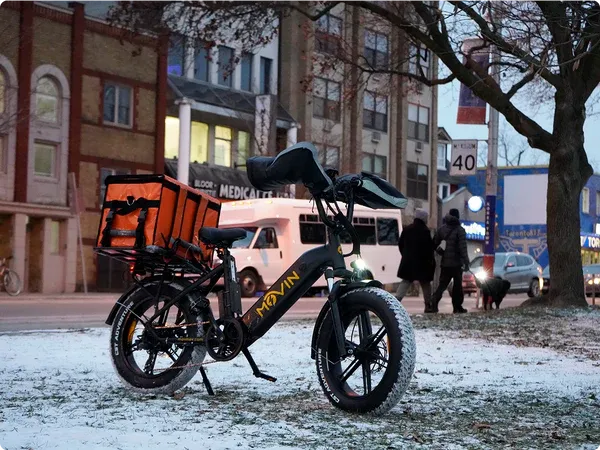 The sight of a loaded cargo e-bike moving through city streets is becoming more familiar in Canada. These electric workhorses give businesses another way to make deliveries and give everyday riders more carrying capacity without moving up to a car or van.
The category itself is broad. Some cargo e-bikes use extended rear racks, some place the load at the front, and others are closer to conventional utility e-bikes with reinforced frames and racks. The right design depends on what needs to be carried, how far the rider travels, and where the bike will be stored.
Common Uses: From Last-Mile Delivery to Family Errands
Cargo and utility e-bikes are useful because the same basic idea can serve very different riders.
- Last-mile deliveries: Couriers and local businesses can use cargo and delivery e-bikes for food orders, groceries, parcels, and other short urban trips.
- Family transport: Some purpose-built cargo bikes are designed to carry passengers or children when used with manufacturer-approved seating and safety equipment. Always check the bike's passenger rating and local rules before carrying another person.
- Grocery runs and errands: Reinforced racks, panniers, baskets, and cargo bags can make it easier to carry groceries, pet supplies, sports gear, or other everyday items.
- Work equipment: Utility e-bikes can also be useful for riders who regularly transport tools, bags, supplies, or equipment around the city.
The main advantage is flexibility. Riders can use electric assistance for the extra weight while still keeping the smaller footprint and manoeuvrability of a bicycle.
Cargo E-Bike Programs and Toronto's Urban Pilot
Cargo e-bikes are also part of wider transportation planning in Canadian cities.
The City of Toronto participates in Ontario's cargo e-bike pilot, which permits cargo e-bikes for both personal and commercial use under specific provincial and municipal rules. The current provincial pilot is scheduled to continue until March 1, 2031.
Toronto specifically recognizes uses ranging from last-mile delivery and school transportation to grocery trips, showing how cargo bikes are being considered as more than just recreational bicycles.
Riders should still check the current rules for their specific bike. Size, weight, motor output, whether the bike can move without pedalling, and the type of cycling infrastructure can all affect where it may be operated.
Source: City of Toronto cargo bike guidance.
Fighting Congestion and Reducing Urban Pollution
Cargo e-bikes can be particularly useful for trips where using a full-size vehicle is unnecessary. They occupy less space, are easier to park, and produce no direct tailpipe emissions during operation.
 For dense urban routes, some practical advantages include:
- Less space required: Cargo bikes take up substantially less road and parking space than cars or delivery vans.
- No tailpipe emissions: Electric bikes do not produce exhaust emissions while being ridden.
- Easier parking: Riders do not need a conventional vehicle parking space for every stop.
- Useful for short urban trips: Deliveries and errands involving frequent stops are a natural use case for cargo e-bikes.
For riders who work commercially, a purpose-built professional delivery e-bike for urban routes can offer features such as a reinforced rack, long-range battery options, hydraulic brakes, and tires designed for daily city riding.
Why Canadian Riding Conditions Matter
Canadian urban riding can mean potholes, road salt, wet pavement, slush, snow, temperature swings, and rough surfaces. Those conditions matter even more when the bike is being ridden daily or carrying additional cargo.
That makes features such as strong brakes, appropriate tires, reliable components, accessible replacement parts, and proper battery care particularly important.
Movin's delivery-focused models are designed and tested around Canadian conditions, while regular maintenance helps any e-bike handle year-round riding more reliably. For a deeper look at seasonal upkeep, see the year-round e-bike maintenance guide for Canada.
Why Cargo E-Bikes Are Gaining Popularity in Canada
Cargo e-bikes fit into a growing gap between a conventional bicycle and a full-size vehicle. For many short urban trips, riders want more carrying capacity than a commuter bike provides without needing a car every time they leave home.
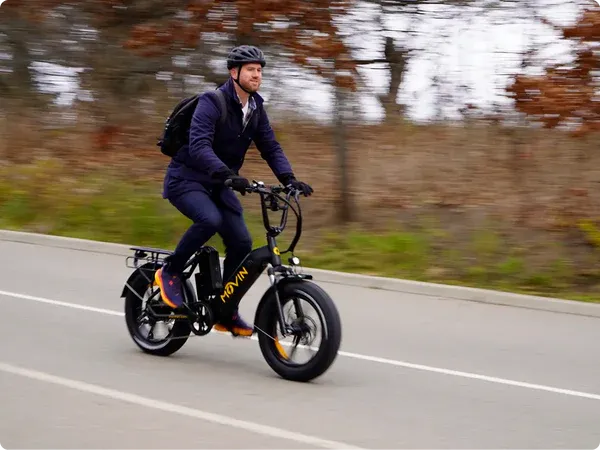
Urban Life Calls for Practical Solutions
Parking is limited in many Canadian city centres, traffic makes short vehicle trips frustrating, and delivery riders often need to stop repeatedly throughout a shift.
A cargo e-bike can make sense in those situations because the rider can carry more than they could on a conventional bike while retaining a relatively compact vehicle.
That can make cargo bikes useful for:
- Food and grocery deliveries
- Courier work
- Daily errands
- Small-business transportation
- Carrying equipment or supplies
- Some family transportation setups
Technology Has Made Cargo E-Bikes More Practical
Modern electric cargo bikes can now be equipped with larger-capacity batteries, hydraulic disc brakes, wide tires, integrated lighting, reinforced racks, and other features aimed at riders who spend more time on the road.
Battery choice is especially important. A rider travelling a few kilometres for errands has very different needs from a courier working an eight-hour shift.
If range is a priority, Movin's guide to dual-battery vs. single-battery e-bikes explains how additional battery capacity affects range, bike weight, and everyday use.
Movin's Pulse professional delivery e-bike specifications are one example of how a delivery-focused model differs from a basic commuter bike.

Practical Benefits Add Up
For the right rider, a cargo e-bike can solve several everyday problems at once:
- More carrying capacity: Cargo-specific racks and frames can support larger loads than a standard commuter setup. Always follow the manufacturer's published limits.
- Lower operating needs than a car: An e-bike does not require gasoline and typically has fewer systems to maintain than a motor vehicle.
- Easier urban parking: Bikes can be secured in spaces where parking a car or van would not be practical, subject to local rules.
- Electric assistance: Pedal assistance makes it easier to move additional weight and cover longer urban routes.
- Different battery options: Riders can choose between simpler single-battery setups and longer-range dual-battery models depending on their route.
Delivery riders can find more job-specific advice in the delivery e-bike Canada guide.
What Should You Look for in a Cargo E-Bike?
Cargo bikes in Canada serve different purposes, so there is no single specification that makes one model best for everybody.
A family running local errands, a small business transporting supplies, and a full-time food courier will prioritize different things.
| Factor | Why It Matters | Who Should Pay Extra Attention |
|---|---|---|
| Cargo capacity | Determines how much the rack or cargo area can safely support. | Delivery riders, businesses, grocery users |
| Battery range | Extra weight, hills, cold weather and assist level can reduce real-world range. | Couriers and long-distance riders |
| Brakes | A heavier loaded bike needs predictable stopping performance. | Anyone regularly carrying substantial loads |
| Tires | Tire width, tread and puncture resistance affect comfort and control. | Year-round and high-mileage riders |
| Bike size and fit | The rider still needs to comfortably start, stop and control the bike when loaded. | All riders |
| Storage | Cargo bikes are often larger and heavier than commuter e-bikes. | Apartment and condo residents |
| Service and parts | Downtime matters when the bike is used every day for work. | Professional delivery riders |
Cargo Capacity
Start with what you plan to carry.
Look at both the rack's published capacity and the manufacturer's total payload limit. Do not assume a large-looking rear rack can safely hold any amount of weight.
For example, the current Movin Pulse rear rack is rated for up to 50 kg, making it suitable for delivery bags, groceries, parcels, and other commercial loads within the manufacturer's limits.
Battery and Real-World Range
Advertised range is useful for comparison, but actual range changes with rider weight, cargo, temperature, terrain, tire pressure, wind, speed, and assist level.
This matters particularly in Canada because cold temperatures can reduce battery performance. Riders using their bikes throughout the winter should also pay attention to how and where the battery is stored and charged.
See Movin's winter e-bike battery storage and care guide for more detailed cold-weather advice.
Brakes and Tires
Cargo adds weight, and weight changes how a bike accelerates, corners, and stops.
Strong brakes and tires suited to the riding surface should therefore be treated as core equipment rather than optional upgrades.
Delivery-focused models commonly use hydraulic disc brakes because they offer controlled braking during repeated city stops. Wider or fat tires can provide additional comfort and stability on rough pavement, although they also add weight and rolling resistance.
Bike Fit Still Matters
A cargo bike should still fit the rider properly. You need to be able to mount the bike, reach the controls comfortably, put a foot down when stopping, and control it confidently when carrying a load.
If you're unsure about frame fit, use Movin's guide to choosing the right e-bike size before buying.
Cargo E-Bikes for Delivery Riders
Professional delivery is one of the most demanding uses for an electric bike. Riders may spend hours starting, stopping, carrying orders, climbing hills, and riding through changing weather.
For delivery work, focus on:
- Enough real-world battery capacity for your normal shift
- A rack that fits and safely supports your delivery setup
- Hydraulic or similarly dependable braking
- Puncture-resistant or durable tires
- Replacement parts and local service
- A comfortable riding position for long shifts
- Lights and visibility equipment
The Movin delivery e-bike hub goes deeper into how range, cargo capacity and city riding affect professional couriers.
For Toronto riders specifically, the guide to food delivery e-bikes in Toronto covers the requirements of app-based delivery work in more detail.
Cargo E-Bikes for Families and Everyday Errands
Not every cargo bike needs to spend eight hours a day making deliveries.
Electric cargo bikes can also be useful for grocery runs, carrying bags and equipment, household errands, or other trips where a conventional bicycle does not provide enough storage.
For casual and household use, riders may care more about:
- Easy mounting and dismounting
- Stable low-speed handling
- Secure baskets or panniers
- Comfort
- Battery removability
- Storage at home
- Simple charging
- Overall bike weight
If a cargo bike will be used to transport children or another passenger, use only a bike and seating system approved for that purpose and follow the manufacturer's weight limits and local regulations.
What Are the Rules for Cargo E-Bikes in Ontario?
Rules matter when comparing an electric cargo bike in Canada because requirements can differ between provinces and municipalities.
For standard e-bikes operated on Ontario roads, the province currently requires:
- A maximum assisted speed of 32 km/h
- An electric motor not exceeding 500 watts
- A rider age of at least 16
- An approved bicycle or motorcycle helmet
- Working pedals and required braking systems
Ontario also has additional rules covering vehicle weight, dimensions and cargo power-assisted bicycles.
Source: Ontario Ministry of Transportation.
What About Cargo Bikes in Toronto?
Toronto has additional rules governing where different cargo e-bikes can operate.
The City states that cargo e-bikes capable of operating without muscular power are not permitted in cycle tracks or on trails. Cargo e-bikes with motor output above 500 watts are also restricted from cycle tracks and trails, while additional weight-related rules apply to trails and large cargo e-bikes.
Because Toronto's rules distinguish between vehicle types, riders should check the City's current cargo-bike guidance rather than assuming every electric cargo bike can use the same infrastructure.
Source: City of Toronto.
The Challenges and Future of Cargo E-Bikes in Canadian Cities
Cargo e-bikes solve real transportation problems, but that does not mean they are the right solution for every rider or every trip.
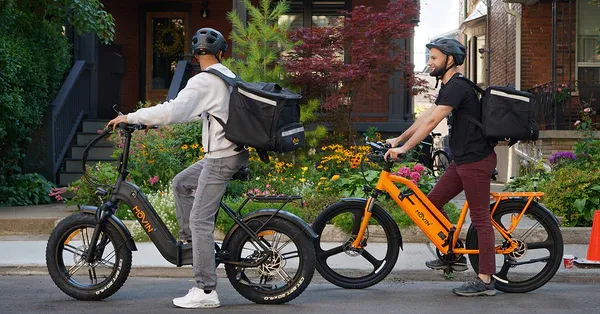
Higher Upfront Cost
Cargo e-bikes generally require a larger initial investment than entry-level conventional bikes. Purpose-built models may include reinforced frames, larger batteries, heavy-duty racks, hydraulic brakes, upgraded tires, and other components intended to carry additional loads.
Rather than looking only at the sticker price, compare:
- Battery size and replacement cost
- Cargo capacity
- Warranty coverage
- Service availability
- Replacement part availability
- Included racks or accessories
- Expected daily use
Movin's cargo delivery e-bike collection lets riders compare current options and specifications, while the e-bike financing page explains available payment options.
Storage and Charging Can Be Difficult
Cargo e-bikes tend to be heavier and longer than standard commuter bicycles, which can create practical problems for riders living in apartments or condos.
Before buying, ask yourself:
- Will the bike fit through my door or elevator?
- Can I securely store it indoors?
- Is the battery removable for indoor charging?
- Is there a secure place to park it at work?
- Can I comfortably move the bike when the battery is empty?
A cargo e-bike that performs perfectly on the road can still be inconvenient if there is nowhere practical to store or charge it.
Winter Conditions Still Require Preparation
Winter remains one of the biggest differences between riding in Canada and riding in a milder climate.
Cold weather affects battery range, while snow, slush, road salt, and ice increase the importance of tire condition, braking, cleaning, and storage.
Riders planning to use a cargo e-bike year-round should:
- Store the battery indoors when practical
- Allow a cold battery to warm before charging
- Check tire pressure regularly
- Clean salt and road grime from the bike
- Inspect brake pads and rotors
- Use appropriate lights and visibility equipment
- Adjust speed and stopping distance for conditions
For more seasonal riding advice, see Movin's guide to riding an e-bike in winter and rain.
Ongoing Design Improvements for Tough Conditions
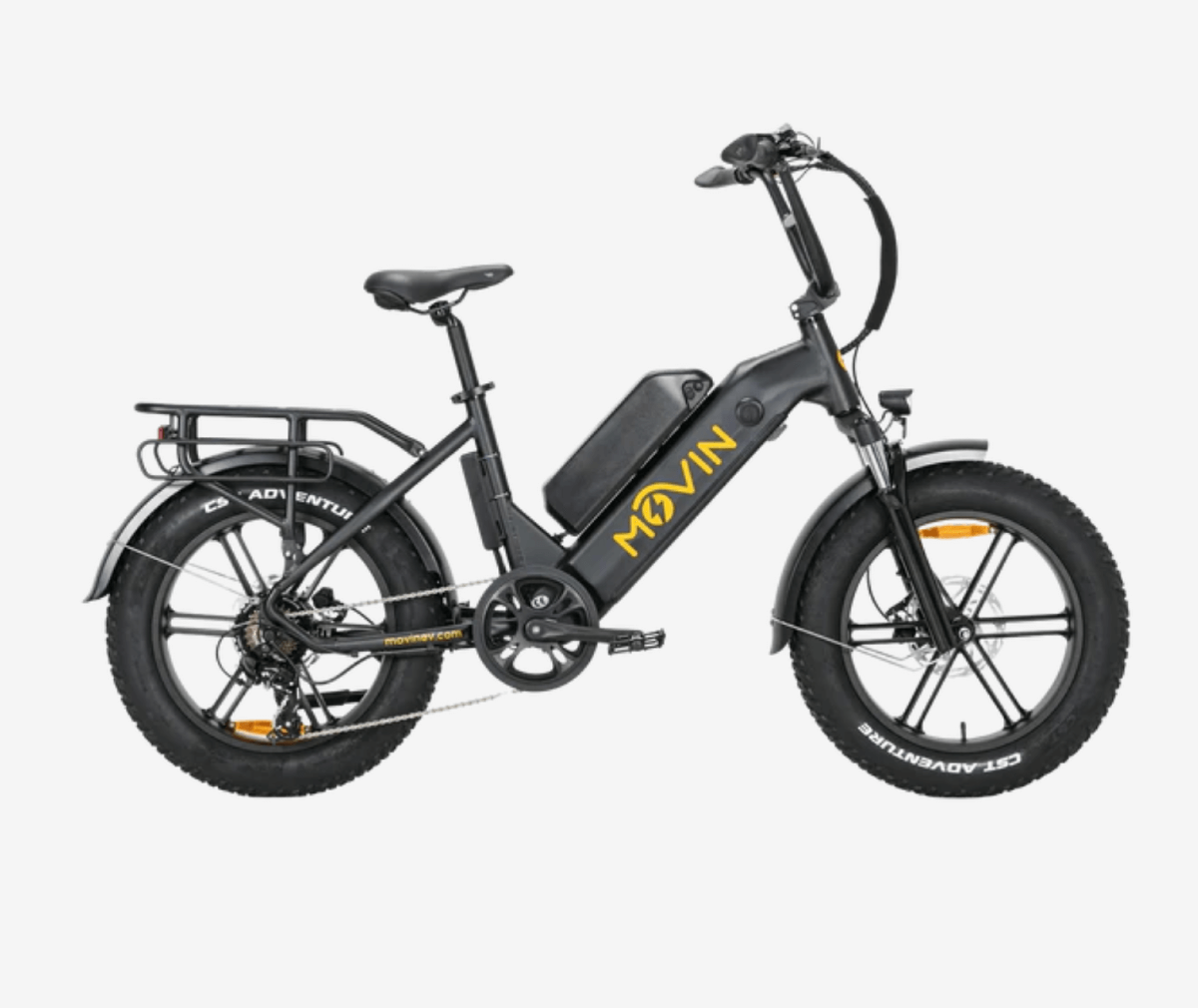
Canadian roads put e-bike components through repeated exposure to potholes, moisture, road salt, temperature changes, and high-mileage use.
Delivery-focused cargo bikes increasingly address those demands with features such as:
- Reinforced frames and racks designed around additional cargo
- Dual-battery options for riders who need longer daily range
- Hydraulic disc brakes for repeated urban stopping
- Wide or fat tires for rough pavement and changing conditions
- Integrated lighting for visibility during early or late shifts
- Serviceable components that can be maintained when the bike is used heavily
The Movin Pulse professional delivery e-bike is one example of a model built specifically around those requirements.
Movin Pulse: A Cargo Option Built for Professional Delivery
The Movin Pulse is better described as a professional delivery and utility e-bike than a traditional front-box family cargo bike.
Its current configuration includes:
- 500W rear hub motor
- 32 km/h assisted top speed
- Up to 150 km range with the dual-battery configuration, depending on conditions
- Rear rack rated for up to 50 kg
- 20 × 4-inch fat tires
- Hydraulic disc brakes
- Single and dual-battery options
Those features make it particularly relevant for food couriers, grocery delivery riders, and other people who need to carry cargo over long urban routes.
A rider who only needs an e-bike for a short daily commute may not need the same cargo capacity or dual-battery setup. In that case, comparing the wider Movin electric bike collection can help identify a better match.
Cargo E-Bike Canada Checklist: What to Consider Before You Buy
If you're comparing cargo e-bikes in Canada, run through these questions before deciding:
- What will I normally carry?
- How much does that load weigh?
- How many kilometres do I ride on a typical day?
- Do I need one battery or a dual-battery setup?
- Can I safely store the bike at home?
- Can I remove the battery for charging?
- Does the bike fit my height and riding position?
- Does the rack have a published weight limit?
- Does the bike comply with the rules where I plan to ride?
- Are parts and repairs available locally?
- Will I ride through winter?
- Do I actually need a cargo bike, or would a commuter e-bike be enough?
For riders who depend on their bike every day, access to maintenance can be just as important as the specifications. Movin's e-bike maintenance guide covers the checks that become more important with frequent riding.
The Future of Cargo E-Bikes in Canadian Cities
The original appeal of cargo e-bikes remains straightforward: they give riders more carrying ability without requiring a full-size vehicle for every trip.
As Canadian cities continue experimenting with cargo-bike policy, cycling infrastructure, commercial delivery use, and urban micromobility, cargo e-bikes are likely to remain part of the transportation mix.
The biggest improvements will not come from one feature alone. Better batteries, reliable brakes, easier access to service, safer infrastructure, clearer regulations, and designs suited to different use cases all make these bikes easier to use in daily life.
For professional riders, the focus will continue to be range, durability, cargo capacity, and keeping the bike working through long shifts. For everyday riders, comfort, storage, simplicity, and flexibility may matter more.
Frequently Asked Questions About Cargo E-Bikes in Canada
What is a cargo e-bike?
A cargo e-bike is an electric bicycle designed to carry more cargo than a typical commuter bike. Depending on the design, it may use an extended rear rack, front cargo area, reinforced frame, baskets, panniers, or other cargo-specific equipment.
Are cargo e-bikes legal in Canada?
E-bike and cargo-bike rules vary by province and municipality. Riders should check the requirements where they live, particularly for motor power, assisted speed, vehicle weight, passenger use, and where the bike may be ridden.
Are cargo e-bikes legal in Toronto?
Yes, qualifying cargo e-bikes can be used in Toronto, but different rules apply depending on the bike's design, power, weight, and whether it can operate without muscular power. Toronto participates in Ontario's cargo e-bike pilot and publishes specific rules for cargo-bike use.
Are cargo bikes good for food delivery?
They can be. Delivery-focused cargo e-bikes provide extra carrying capacity and can be equipped with larger batteries, strong brakes, reinforced racks, and tires suited to repeated urban riding. See Movin's Canada delivery e-bike guide for more detail.
How much can a cargo e-bike carry?
There is no universal cargo limit. It depends on the bike, frame, rack, and manufacturer's stated payload limits. The Movin Pulse, for example, has an integrated rear rack rated for up to 50 kg.
Do I need a dual-battery cargo e-bike?
Not necessarily. A single battery may be enough for errands, commuting, and shorter routes. Dual-battery setups are more useful for riders covering long distances or working extended delivery shifts without convenient charging access.
Can you ride a cargo e-bike in Canadian winter?
Yes, but winter riding requires more preparation. Cold temperatures affect battery range, while snow, salt, slush and ice increase the need for tire, brake and battery care. Always adjust your riding to the conditions.
Is a cargo e-bike better than a commuter e-bike?
It depends on what you carry. A commuter e-bike is usually lighter and easier to store if you mainly transport yourself and a small bag. A cargo or delivery e-bike makes more sense when carrying groceries, delivery bags, equipment, parcels, or other heavier loads is a regular part of the ride.
Conclusion
Cargo e-bikes in Canada are no longer limited to one type of rider. They are being used for deliveries, errands, business transportation, and everyday urban travel because they combine the carrying ability of a utility bike with electric assistance.
The right cargo e-bike depends on the job. Professional riders should pay close attention to battery range, rack capacity, braking, tire durability, service, and daily comfort. Everyday riders may prioritize storage, fit, ease of use, and how much cargo they realistically need to carry.
Canadian weather and local regulations also matter, so compare more than the headline range or motor specification before buying.
If you're looking for a bike built specifically around delivery and cargo use, explore Movin's cargo and delivery e-bikes or take a closer look at the Movin Pulse professional delivery e-bike.
Compare Cargo & Delivery E-Bikes →
Already delivering in Toronto? See how food delivery e-bikes in Toronto are being used for last-mile work across the city.