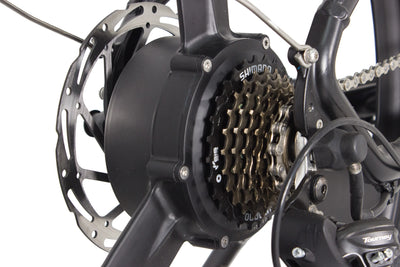
Whether you're buying your first e-bike or upgrading your current ride, understanding the motor is essential. The motor affects how an electric bike accelerates, climbs hills, handles extra weight, and uses battery power. In this guide, we break down the main types of electric bike motors, important specifications, Ontario motor rules, maintenance, and real-world use cases to help you choose the right setup for your ride.
What Is an Electric Bike Motor and How Does It Work?
An electric bike motor converts electrical energy from the battery into mechanical assistance that helps move the bike forward.
How that assistance starts depends on the bike's control system:
- Pedal assist (PAS) activates motor support while you pedal. The amount of assistance depends on the selected assist level and the bike's sensor system.
- Throttle mode can provide motor assistance without requiring the rider to pedal, where the bike and local rules allow it.
The motor is only one part of the electric system. The battery, controller, sensors, display, drivetrain, tires, rider weight, terrain, and riding mode all affect how an e-bike feels and performs.
It is also useful to understand the battery numbers correctly. Voltage (V) describes electrical potential, while amp-hours (Ah) describe charge capacity. Watt-hours (Wh) are a more useful measure of the battery's total stored energy and therefore help when comparing potential range.
For example, a 48V 20Ah battery contains approximately 960Wh of energy. The current Movin Tempo Max uses a Samsung 48V 20Ah battery rated at 960Wh.
For a deeper look at battery capacity, charging, compatibility, and range, see the Movin e-bike battery guide.
Technical source: Bosch eBike Systems, Battery Knowledge. Bosch defines voltage as electrical potential, amp-hours as charge capacity, and watt-hours as battery energy content. Source checked August 11, 2026.
Electric Bike Motor Specifications: What Do the Numbers Mean?
Motor specifications can look confusing because watts, torque, voltage, battery capacity, sensors, and motor placement all describe different parts of the riding experience.
| Specification | What It Means | Why It Matters |
|---|---|---|
| Rated Power (W) | The power level the motor is designed to provide continuously under its rated operating conditions. | Useful for comparing continuous motor capability and checking local e-bike regulations. |
| Peak Power (W) | The higher output a motor may be capable of for a short period under suitable conditions. | Can affect short bursts of performance, but should not be confused with the motor's rated continuous output. |
| Torque (Nm) | Rotational force produced by the motor. | Higher torque can support stronger acceleration, hill starts, and heavier loads. |
| Voltage (V) | Electrical voltage of the bike's battery system. | Part of the electrical system that determines how power is delivered. |
| Amp-Hours (Ah) | A measure of battery charge capacity. | Useful when comparing batteries with the same voltage, but does not by itself tell you the total stored energy. |
| Watt-Hours (Wh) | A measure of the battery's energy content. | One of the most useful battery numbers when comparing potential range. |
| Sensor Type | Common systems include cadence and torque sensors. | Changes how quickly and naturally the motor responds to your pedaling. |
| Motor Placement | Usually mid-drive, direct-drive hub, or geared hub. | Affects weight distribution, drivetrain load, service requirements, and ride feel. |
Do not judge an electric bike motor from one number alone. A 500W motor with the right gearing, controller, sensor setup, battery, and tires can feel very different from another motor with the same rated wattage.
Types of Electric Bike Motors: Mid-Drive, Direct-Drive Hub, and Geared Hub
E-bike motors generally fall into three main categories. Each design has advantages and trade-offs depending on how and where you ride.
Mid-Drive or Central-Drive Motors
A mid-drive motor sits around the crank or bottom-bracket area and sends motor power through the bike's drivetrain.
- Pros: Central weight distribution, strong climbing ability, and the ability to take advantage of the bike's gearing.
- Cons: Usually more expensive and can place additional wear on chains, cassettes, and other drivetrain components.
Mid-drive motors can be a strong choice for riders dealing with steep terrain, mountain riding, or loads where being able to use the bicycle's gears effectively is important.
Rear-Hub Direct-Drive Motors
A direct-drive hub motor is built into the wheel and uses electromagnetic force without an internal gear-reduction system.
- Pros: Simple internal design, quiet operation, and relatively few moving motor parts.
- Cons: Usually heavier than a comparable geared hub motor and can feel less responsive during low-speed starts or steep climbing.
Direct-drive systems are often attractive for riders who prioritize smooth, quiet cruising over compact size or low-speed torque.
Geared Hub Motors
Geared hub motors are also built into the front or rear wheel, but they use internal reduction gears that allow the electric motor to spin faster while delivering usable wheel torque.
- Pros: Compact size, relatively low weight, responsive acceleration, and useful low-speed torque.
- Cons: Internal gears add moving components that can eventually wear, particularly under heavy or sustained loads.
Movin currently uses rear-hub motor systems on models such as the Tempo Max commuter e-bike and Pulse delivery e-bike.
The table below compares the general characteristics of the three electric bike motor types.
| Feature | Mid-Drive | Direct-Drive Hub | Geared Hub |
|---|---|---|---|
| Placement | Crank / bottom bracket | Usually rear wheel | Front or rear wheel |
| How Power Reaches the Wheel | Through the bicycle drivetrain | Motor directly rotates the hub | Internal gears reduce motor speed and drive the hub |
| Weight Distribution | Central | More weight at the powered wheel | More weight at the powered wheel, usually lighter than direct drive |
| Low-Speed Acceleration | Strong, especially when using the bike's gears | Usually more gradual | Typically responsive |
| Hill / Load Performance | Strong when correctly geared | Depends heavily on motor size and operating speed | Strong for its compact size |
| Noise | Varies by system | Typically very quiet | May produce some gear noise |
| Drivetrain Wear | Motor power passes through chain and gears | Motor operates independently of the bicycle drivetrain | Motor operates independently of the bicycle drivetrain |
| Motor Service Complexity | Generally more specialized | Simple motor architecture | Internal gears add serviceable wear components |
| Common Fit | Hills, performance riding, technical terrain | Quiet cruising and simple high-mileage use | Commuting, city riding, delivery, utility riding |
If you want a more detailed side-by-side comparison, read the full mid-drive vs. hub-drive e-bike guide.
Infographic: Torque vs Speed by Motor Type
Different motor designs prioritize torque, motor speed, weight, and efficiency differently. Geared hub motors can provide strong low-speed assistance in a relatively compact package, which is one reason they are commonly used on commuter and utility e-bikes.

Why Torque and Motor Power Matter
Torque and power describe related but different aspects of an electric bike motor.
- Torque (Nm): Rotational force. It is especially noticeable during acceleration, hill starts, and when carrying additional weight.
- Power (W): The rate at which the motor performs work. E-bike specifications usually distinguish between rated continuous power and, where the manufacturer publishes it, short-duration maximum or peak output.
Bosch eBike Systems explains that a higher-torque drive unit can provide stronger acceleration and make it easier to move heavier loads. Maximum torque is normally called on during demanding situations such as acceleration or steep climbing rather than being produced continuously.
As a manufacturer example, Bafang's current H405 rear-hub motor is offered with a 500W rated-power configuration and up to 60 Nm of torque. Bafang positions the motor for eCity and eTour applications.
This does not mean every 500W motor produces 60 Nm or behaves the same way. Motor architecture, controller programming, gearing, wheel diameter, battery voltage, sensor type, and the bike itself all influence real-world performance.
Sources: Bosch eBike Systems, Torque in the Context of the Drive Unit; Bafang H405 official motor specifications. Sources checked August 11, 2026.
How Much E-Bike Motor Power Is Legal in Ontario?
E-bike laws are provincial, so Canada does not use one universal Class 1, Class 2, Class 3, and Class 4 system for every rider and every province. Riders should check the rules where they live and where they plan to ride.
For Ontario, the Government of Ontario currently states that an e-bike must have:
- A maximum assisted speed of 32 km/h
- An electric motor that does not exceed 500 watts
- A maximum bike-and-battery weight of 120 kg
- Working pedals
- A securely attached battery and motor
- Properly insulated electrical terminals
- Two independent braking systems that meet the province's stopping requirement
Ontario also states that it is illegal to modify an e-bike motor so that it exceeds the province's 500W power limit or 32 km/h assisted-speed limit.
The current Movin Tempo Max and Movin Pulse are both published with 500W motor systems and an assisted top speed of 32 km/h.
Where an e-bike can be ridden may still depend on provincial and municipal rules. See Movin's full guide to e-bike laws in Canada for more location-specific information.
Source: Government of Ontario, Riding an e-bike, updated July 19, 2024; requirements checked August 11, 2026.
Bafang Hub Motors: What Should You Look at?
Bafang manufactures a wide range of hub and mid-drive motor systems, so the brand name alone does not tell you how an e-bike will perform. The exact motor model and specification matter.
For example, Bafang publishes its H405 rear-drive motor with:
- 250W or 500W rated-power options
- Up to 55–60 Nm of torque, depending on configuration
- 3.7 kg motor weight
- Compatibility with disc brakes
- A design intended for eCity and eTour applications
Those specifications are a useful example of how to read a motor datasheet: look at rated power, torque, weight, intended application, and compatibility instead of judging a motor from wattage alone.
Movin's current product specifications describe the Pulse as using a 48V 500W brushless rear-hub motor with planetary gearing. The Tempo Max is also currently listed with a 48V 500W brushless geared hub motor.
Sources: Bafang H405 official specifications; Movin Pulse and Tempo Max product specifications. Checked August 11, 2026.
How to Get Better E-Bike Motor Performance Legally
Getting better performance does not necessarily mean increasing the motor's speed limit. Often, basic setup and maintenance make a noticeable difference.
- Choose the right pedal-assist level: Higher assistance provides more motor support but generally consumes battery energy faster.
- Maintain correct tire pressure: Underinflated tires increase rolling resistance and can reduce efficiency.
- Use your bicycle gears properly: Keeping a comfortable cadence helps the rider and motor work together more effectively, particularly on hills.
- Keep the battery appropriately charged: Motor performance depends on the electrical system being able to supply the required power.
- Remove unnecessary weight: Heavier total loads require more energy to accelerate and climb.
- Keep the drivetrain and brakes in good condition: Dragging brakes, worn bearings, or a poorly maintained drivetrain can waste energy.
A larger-capacity battery does not automatically make an e-bike faster. Increasing Ah or Wh at the same system voltage mainly gives the bike more available battery energy and can extend range. Top assisted speed is controlled by the motor/controller system and, for road use, the applicable legal limit.
For more on this relationship, see the guide to balancing e-bike speed and range.
Avoid unlocking, reprogramming, or modifying a motor in a way that makes the bike exceed the legal requirements for where you ride. In Ontario, modifying an e-bike beyond 500W or 32 km/h means it no longer meets the province's standard e-bike requirements.
Maintenance Checklist for Your E-Bike Motor
Electric bike motors generally require less routine attention than chains, brakes, or tires, but the motor system should still be inspected regularly. Hub motors also put extra importance on wheel, axle, cable, and connector condition.
| Task | What to Check | Suggested Timing |
|---|---|---|
| Visual Inspection | Check the motor housing, wheel, cables, and connectors for visible damage. | Monthly and before long rides |
| Motor Axle & Fasteners | Check that the powered wheel and required motor fasteners remain secure. | Monthly or after wheel service |
| Battery & Electrical Check | Watch for unusual errors, intermittent power, damaged wiring, or loose connections. | Monthly |
| Housing Cleaning | Wipe away dirt, salt, and road grime without directing high-pressure water at electrical components. | As needed, especially after wet or winter rides |
| Cable Inspection | Look for pinching, abrasion, damaged insulation, or loose connectors. | Every few months |
| Software / Firmware | Install manufacturer-approved updates if the specific motor system supports them. | When an official update is available |
| Professional Diagnosis | Have persistent noises, error codes, power loss, or unusual behaviour professionally inspected. | When symptoms appear or during major service |
Do not open a sealed motor housing unless the manufacturer specifically allows user servicing and you have the correct knowledge and tools. Opening electrical components can damage seals, create safety issues, or affect warranty coverage.
For maintenance and troubleshooting help, see Movin's e-bike repair guide or visit the Movin repair and service centre.
Rated Power vs. Peak Motor Output
Rated and peak power are often mixed together in e-bike marketing, but they do not mean the same thing.
- Rated continuous power: The motor output it is designed to provide continuously under its rated operating conditions without overheating or damage.
- Maximum or peak power: A higher output the motor may produce temporarily under suitable conditions, if the manufacturer specifies one.
Bosch eBike Systems similarly distinguishes rated continuous output from maximum mechanical power, which can be available briefly when conditions allow.
For legal comparisons, use the specification relevant to your province's regulations rather than assuming that an advertised peak figure determines whether the bike is road legal.
Movin's current Pulse and Tempo Max specifications publish their motor systems at 500W. Because the current product pages do not publish a verified peak-wattage specification, we recommend using the stated 500W rating when comparing these models.
Sources: Bosch eBike Systems, Power in the Context of the Drive Unit; Movin Pulse and Tempo Max product specifications. Checked August 11, 2026.
Final Buying Tips: Matching Motor Type to Your Needs
| Riding Need | Motor Type to Consider | Why |
|---|---|---|
| Steep hills | Mid-drive or high-torque geared hub | Both can provide strong low-speed assistance when properly matched to the bike. |
| Cargo / Delivery | Geared hub or cargo-focused mid-drive | Prioritize torque, braking, battery capacity, serviceability, and load rating. |
| Stop-and-Go Commuting | Geared hub | Compact design and responsive acceleration can work well in urban traffic. |
| Natural Pedaling Feel | Mid-drive with torque sensing | Motor assistance is integrated through the drivetrain and can respond closely to rider effort. |
| Quiet Cruising | Direct-drive hub | Simple, gearless internal design can operate very quietly. |
| Simpler Bicycle Drivetrain | Hub motor | Motor power bypasses the chain and cassette rather than being transmitted through them. |
| Long Range | Depends on the complete system | Battery Wh, motor efficiency, assist level, terrain, speed, tires, rider weight, and weather all matter. |
Frequently Asked Questions About Electric Bike Motors
What are the main types of electric bike motors?
The three common types are mid-drive motors, direct-drive hub motors, and geared hub motors. Mid-drives send power through the bicycle drivetrain, while hub motors are built into a wheel. Geared hub motors use internal reduction gears, while direct-drive hubs operate without an internal gear reduction system.
Is a 500W e-bike motor powerful enough?
For many commuters, delivery riders, and everyday urban riders, a properly configured 500W system can provide strong assistance. Performance also depends on torque, gearing, controller tuning, wheel size, battery condition, rider and cargo weight, and terrain. In Ontario, 500W is also the current maximum motor output for an e-bike that meets the province's standard requirements.
What does torque mean on an e-bike motor?
Torque is rotational force and is measured in Newton metres (Nm). Higher available torque can improve acceleration and make it easier to start on hills or move additional weight, although the motor's complete power curve and bike setup also matter.
Is a mid-drive motor better than a hub motor?
Not universally. Mid-drive motors can make effective use of the bicycle's gears and work well on steep or technical terrain. Hub motors separate motor power from the drivetrain and can offer a simpler, cost-effective setup for commuting and utility riding. The better choice depends on how you ride.
Does a bigger e-bike battery make the motor faster?
No, not simply because it has more Ah or Wh. A higher-capacity battery at the same system voltage primarily stores more energy, which can increase available range. Motor speed is determined by the motor, controller, electrical system, and any programmed or legal speed limit.
What is the difference between rated and peak motor power?
Rated power describes the motor's continuous rated output. Peak or maximum power refers to a higher output that may be available for a short period when the manufacturer specifies it. When comparing motors, check which number is being advertised instead of assuming all wattage figures are directly comparable.
Can I install a motor over 500W on an e-bike in Ontario?
An e-bike with a motor output greater than 500W does not meet Ontario's current standard e-bike motor requirement. Ontario also prohibits modifying an e-bike motor to make it exceed 500W or an assisted speed of 32 km/h. Different vehicle rules may then apply.
Which motor type is best for delivery riding?
Delivery riders should look beyond motor type alone. Useful factors include responsive low-speed assistance, adequate torque, a suitable battery, reliable brakes, cargo capacity, tire durability, and access to replacement parts and service. Movin's Pulse delivery e-bike, for example, uses a 500W rear-hub motor as part of a system designed for long urban delivery shifts.
Choose the Electric Bike Motor That Fits Your Ride
There is no universal “best electric bike motor.” A motor that works perfectly for a flat city commute may not be the best choice for steep hills, commercial delivery, mountain riding, or a rider carrying heavy loads.
Pay attention to the complete specification: motor type, rated power, torque, sensor system, battery Wh, bike weight, gearing, brakes, and intended use.
Movin's current commuter and delivery models use 500W hub-motor systems designed around Canadian urban riding. Compare the Tempo Max commuter e-bike, Pulse delivery e-bike, or browse the full Movin electric bike collection to see how different motor and battery setups fit different riders.
Need help choosing? Visit Movin at 654 College Street, Toronto, or chat with the Movin team online.