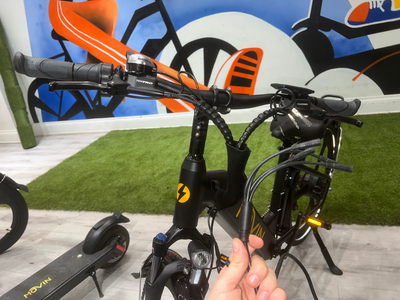
An e-bike throttle lets you activate the motor without relying entirely on pedaling. Depending on the bike, the throttle may be controlled with your thumb or by twisting part or all of the handlebar grip. The main types of e-bike throttles are thumb throttles, half-twist throttles, and full-twist throttles, and each offers a different balance of control, comfort, and riding feel.
For most riders, there is no single throttle type that is automatically better. A thumb throttle keeps your hand firmly around the grip, while a twist throttle can offer smooth and familiar power control. Half-twist throttles sit somewhere between the two and are commonly used on commuter and delivery e-bikes.
Electric bike throttles give riders another way to activate the motor and can be particularly useful when starting from a stop, navigating stop-and-go traffic, or getting extra assistance on an incline. They work alongside, rather than replacing, common pedal-assist modes.
That added control is one reason throttles are found on many e-bikes designed for commuting, delivery work, and everyday riding. For a wider overview of how the throttle fits with the battery, motor and controller, see our electric bike parts guide.
What Is an E-Bike Throttle?
An e-bike throttle is a handlebar-mounted control that tells the bike's electric system to provide motor power. Instead of requiring the rider to increase pedal effort first, the throttle can request power directly when it is engaged.
When you press or twist the throttle, it sends an input to the bike's controller. The controller then manages how much electrical power is sent from the battery to the motor.
On systems with variable throttle control, the amount of throttle input can influence how much power the motor delivers. A light input can provide gradual acceleration, while additional input can request more assistance. The exact response depends on the e-bike's controller, motor, throttle design, and programming.
This can make an electric bike throttle useful when:
- starting from a complete stop
- moving through frequent stop-and-go traffic
- getting initial assistance before pedaling
- climbing an incline
- carrying additional cargo
- maintaining control in situations where immediate motor assistance is useful
A throttle and pedal assist serve different purposes. Pedal assist responds while you pedal, whereas a throttle gives you a separate handlebar control for requesting motor assistance.

Types of E-Bike Throttle Controls
Although throttle designs vary between manufacturers, most electric bike throttles fall into three common categories: thumb throttles, half-twist throttles, and full-twist throttles.
1. Thumb Throttle
A thumb throttle uses a small lever or paddle positioned near the handlebar grip. The rider keeps their hand around the grip and presses the throttle with their thumb when motor assistance is needed.
The main advantage is that the grip itself does not have to rotate. That gives riders a fixed hand position and can make the control feel straightforward, especially for riders who have never used motorcycle-style controls.
The trade-off is that continuously holding a thumb lever can become tiring during longer periods of throttle use.
2. Half-Twist Throttle
A half-twist throttle uses only a portion of the handlebar grip as the throttle control. The rider rotates that section to request motor power while the remaining portion of the grip stays fixed.
This design combines some of the natural modulation of a twist throttle with a more stable hand position. For riders who regularly use motor assistance in city traffic, it can provide a useful balance between control and comfort.
Half-twist throttles are particularly common on commuter and delivery-oriented e-bikes where riders may frequently start, stop, and adjust power.
3. Full-Twist Throttle
A full-twist throttle turns a larger portion, or essentially all, of the handlebar grip. The action is similar to the throttle control found on a motorcycle or scooter.
For riders already familiar with that style of control, a full-twist throttle can feel very natural. It can also allow progressive power adjustments without requiring the thumb to hold down a separate lever.
However, because the throttle is integrated into the grip, hand and wrist movement can influence throttle input. Some riders prefer the more fixed hand position of a thumb or half-twist system.
Thumb vs Half-Twist vs Full-Twist E-Bike Throttles
| Feature | Thumb Throttle | Half-Twist Throttle | Full-Twist Throttle |
| How it works | Press a lever or paddle with your thumb | Rotate part of the handlebar grip | Rotate most or all of the handlebar grip |
| Hand position | Grip remains fixed | Part of the grip remains fixed | Grip rotates with throttle input |
| Learning curve | Simple for most beginners | Usually easy to learn | Very familiar for motorcycle and scooter riders |
| Power control | Depends on throttle and controller design | Allows progressive twist input on compatible systems | Allows progressive twist input on compatible systems |
| Long-duration use | Thumb fatigue may occur | Balanced hand and wrist position for many riders | Can be comfortable but requires wrist involvement |
| Grip stability | High | High to moderate | Depends more on rider hand position |
| Best suited to | Casual riding, urban riding, riders wanting simple controls | Commuting, delivery riding, frequent throttle use | Riders who prefer motorcycle-style controls |
Keep your throttle system properly powered
Throttle response depends on the battery and controller working together. Browse compatible battery options for selected Movin’ e-bikes.

Which E-Bike Throttle Is Best for You?
The best electric bike throttle depends more on how and where you ride than on one design being universally better than another.
"In my experience, selecting the right throttle type comes down to understanding your riding style and environment. For urban commuting and flat terrains, a thumb throttle offers better safety and ease of use.
However, for more varied and hilly terrains, a twist throttle provides the smooth, responsive control that can significantly enhance your riding experience. Always consider the specific demands of your usual routes and your comfort preferences when making your choice." – Ashgar MovinEV Ebikes Technician
Choose a Thumb Throttle If You Want Simple Controls
A thumb throttle is a strong choice for riders who want to keep both hands in a stable position on the handlebars. Because only the thumb operates the throttle, the rest of the hand can stay wrapped around the grip.
This can work particularly well for urban commuting and flat terrain, where riders frequently stop, start, and make small adjustments in traffic.
A thumb throttle can also feel less intimidating to beginners who are not accustomed to twisting a handlebar grip to control motor power.
Choose a Half-Twist Throttle for a Balance of Control and Comfort
A half-twist throttle can be a good middle ground for riders who want twist-style power control without having the entire grip rotate.
You can keep part of your hand on a fixed section of the grip while using the rotating section to control motor assistance. This is useful for riders who regularly use the throttle but still want a stable grip during daily commuting or delivery work.
For stop-and-go city riding, where you may repeatedly engage and release the throttle throughout the day, that combination can make a half-twist system especially practical.
Choose a Full-Twist Throttle If You Prefer Motorcycle-Style Control
Riders with motorcycle or scooter experience may find a full-twist throttle the most familiar option. Twisting the grip to request power can feel natural and makes it possible to adjust motor input without operating a separate thumb lever.
Full-twist designs may also appeal to riders who want a more active, motorcycle-like riding feel. The main consideration is comfort: because your wrist and grip are directly involved in throttle operation, the experience can be different from using a fixed handlebar grip.
What About Hills and Stop-and-Go Traffic?
Throttle type is only one part of how an e-bike performs on hills or in traffic. The motor, controller, battery, gearing, rider weight, cargo load, and bike setup all affect acceleration and climbing performance.
A throttle can still be valuable in these situations because it gives the rider immediate access to motor assistance.
When starting at an intersection, for example, throttle assistance can help get the bike moving before the rider settles into normal pedaling. For delivery riders who may stop dozens of times during a shift, that convenience can become particularly noticeable.
On hills, smooth throttle control can also help the rider request additional assistance. However, the throttle itself does not create additional motor power. Hill-climbing capability still depends heavily on the motor and the rest of the e-bike's electrical system.
What Throttle Does Movin Use?
Several Movin' e-bikes use a half-twist throttle, including models designed for commuting, folding portability, and professional delivery riding.
The Movin' Pulse Fat Tire Delivery E-Bike uses a dead-start half-twist throttle designed to provide motor power on demand during frequent starts and stops. The Tempo Max commuter e-bike also combines a half-twist throttle with pedal-assist levels for daily urban riding.
The Movin' Mini Folding uses a dead-start half-twist grip throttle as well, giving riders another way to access motor assistance on a compact folding e-bike.
For these types of bikes, the half-twist design provides a practical compromise: riders get twist-based throttle control while retaining a fixed portion of the handlebar grip.
Thumb Throttle vs Twist Throttle for Long Rides
Comfort becomes increasingly important when you spend several hours on an e-bike.
With a thumb throttle, the hand can remain wrapped around a stationary grip, but frequently holding the throttle lever with one thumb may eventually cause fatigue.
A twist throttle distributes the movement differently by using the hand and wrist. Some riders find this more comfortable for repeated use, while others prefer not to rotate their wrist while riding.
A half-twist throttle reduces how much of the grip moves and can therefore offer a compromise between the two.
If long-distance riding is your priority, do not choose a throttle based only on its type. Handlebar position, grip shape, brake lever position, reach, riding posture, and how frequently you actually use the throttle can matter just as much.
Throttle vs Pedal Assist: What's the Difference?
Throttle control and pedal assist both use the e-bike's motor, but the rider interacts with them differently.
Pedal assist detects that the rider is pedaling and then provides motor assistance according to the selected assistance level and the bike's sensor system.
A throttle gives the rider a separate handlebar control for requesting motor assistance.
Many e-bikes combine both systems, allowing riders to pedal normally most of the time while using the throttle when immediate motor assistance is useful.
For example, a commuter might use pedal assist while cruising along a bike lane and briefly use the throttle when starting again after a traffic light.
Are E-Bike Throttles Legal in Canada?
E-bike requirements in Canada can vary by province, municipality, and riding location, so riders should check the rules that apply where they plan to use the bike.
In Ontario, provincial requirements for standard e-bikes include working pedals, an electric motor that does not exceed 500 watts, and a maximum assisted speed of 32 km/h. Ontario also has equipment, rider, and operating requirements that an e-bike must meet to be legally used on public roads.
Municipal rules can further affect where an e-bike may be ridden, including certain roads, bike paths, trails, sidewalks, and other public areas.
Because e-bike regulations can change, it is a good idea to review current provincial and local requirements instead of assuming that the rules in one Canadian city or province apply everywhere.
Frequently Asked Questions About E-Bike Throttles
What does a throttle do on an e-bike?
An e-bike throttle sends a control signal to the bike's electrical system requesting motor assistance. Depending on the bike, you operate it by pressing a thumb lever or twisting part or all of the handlebar grip.
Is a thumb throttle or twist throttle better?
Neither is automatically better. Thumb throttles let you keep the grip stationary and are simple to operate, while twist throttles may provide a more natural control style for riders familiar with motorcycles or scooters. Your riding style and comfort matter more than the name of the throttle.
What is a half-twist throttle?
A half-twist throttle rotates only part of the handlebar grip. This gives the rider twist-style throttle control while leaving another portion of the grip stationary. It is a common option on commuter and delivery-oriented e-bikes.
Can you ride an e-bike without pedaling when it has a throttle?
Some throttle-equipped e-bikes can provide motor assistance without active pedaling, depending on how the bike and controller are configured. The amount of assistance, operating conditions, and legal requirements depend on the specific e-bike and the rules where it is being ridden.
Does a twist throttle make an e-bike faster?
No. Changing from a thumb throttle to a twist throttle does not by itself increase the bike's motor power or legal assisted speed. The throttle is primarily a control interface. Motor output and speed are determined by the bike's motor, controller, battery, programming, and applicable limits.
Are half-twist throttles good for commuting?
They can be. A half-twist throttle allows the rider to keep part of the grip stationary while using a twisting movement to control motor assistance. That can be convenient for urban commuting and repeated stop-and-go riding.
Final Thoughts: Which E-Bike Throttle Should You Choose?
For most riders choosing between e-bike throttles, the decision comes down to comfort and riding style.
- Thumb throttle: a simple option that keeps the handlebar grip stationary.
- Half-twist throttle: a balanced option combining twist control with a partially fixed grip.
- Full-twist throttle: a familiar choice for riders who prefer motorcycle-style controls.
If you mainly commute through busy streets, a thumb or half-twist throttle may provide the type of control you prefer. If you already have experience with motorcycles or scooters, a twist throttle may feel more natural.
More importantly, consider the entire e-bike system rather than judging a bike by its throttle alone. Motor performance, battery capacity, controller tuning, brakes, riding position, and pedal-assist system all contribute to how the bike feels on the road.
The best e-bike throttle is ultimately the one that gives you predictable motor control while allowing you to ride comfortably and confidently.